
Providing food for the birds attracts visitors like this blue tit
I’ve always loved birds and wildlife and enjoy any opportunity to help them out. As a child, if I threw two loaf ends into the back garden I would hardly have time to close the door behind me before scores of starlings, blackbirds, thrushes and sparrows had descended, making short work of the tasty snack. These days, my parents refrain from doing the same, as the bread lies untouched for so long it risks attracting vermin to the garden.
It is a sad fact that over the last couple of decades some British bird species have declined in number drastically. In the 1980s I saw so many house sparrows in the garden but today they are a red-listed species. Determined to help the birds that are left, I decided to set up my own feeding station at home. But before you picture a spacious green garden surrounded by countryside, here is how my story differs from many – I live in a London flat and feed the birds from the window.
Not having a garden I had to make the best of what was available and fortunately, there are window feeders which use suction cups to stay attached. Buying a tray-style one first, I eagerly filled it with suet pellets and waited. And waited. And waited. About 10 weeks later I was beginning to think my attempt at attracting wildlife to such an unlikely place had been rather a waste of time when a blue tit landed on the feeding tray. I could barely breathe with excitement as it hopped about, flying off just a few seconds later. This brave little bird turned out to be the first of many visitors and today The Window Café, as I call it, receives regular visitors every day.
Bluey must have told his friends about this happening new hangout because his species are among the most frequent visitors. Favouring black sunflower seeds and suet pellets, they sit on the tray’s edge, with a seed between their feet, pecking away the shell to get to the heart inside. Coal tits love sunflower seeds too and these little birds are instantly recognisable by the white patch on the back of their heads.
Similarly, great tits also love black sunflower seeds but another favourite of theirs is dried mealworms. Due to their otherwise brittle nature, I soak them in warm water for half an hour before putting them out and this seems to make it easier for the birds to enjoy them.
According to the RSPB, starling numbers have dropped a massive 84% since 1979 but fortunately for me, many of them visit The Window Café. Small flocks will swarm around the tray, wolfing down as many suet pellets and mealworms as possible as quickly as they can. And while smaller species will usually decide who has to get out of the way depending on size, the starlings have no such pecking order and will squawk and peck each other in the face in order to get the lion’s share.
As the months went by I realised different birds have very particular favourite foods and so expanded on The Window Café’s offerings. Noticing the black sunflower seeds were the first thing to go from the tray, I bought a cylindrical window feeder exclusively for them. This soon attracted even more species and I am now visited daily by greenfinches and goldfinches who will happily spend quite a long time sitting on the perches, cracking through large numbers of seeds with their robust beaks.
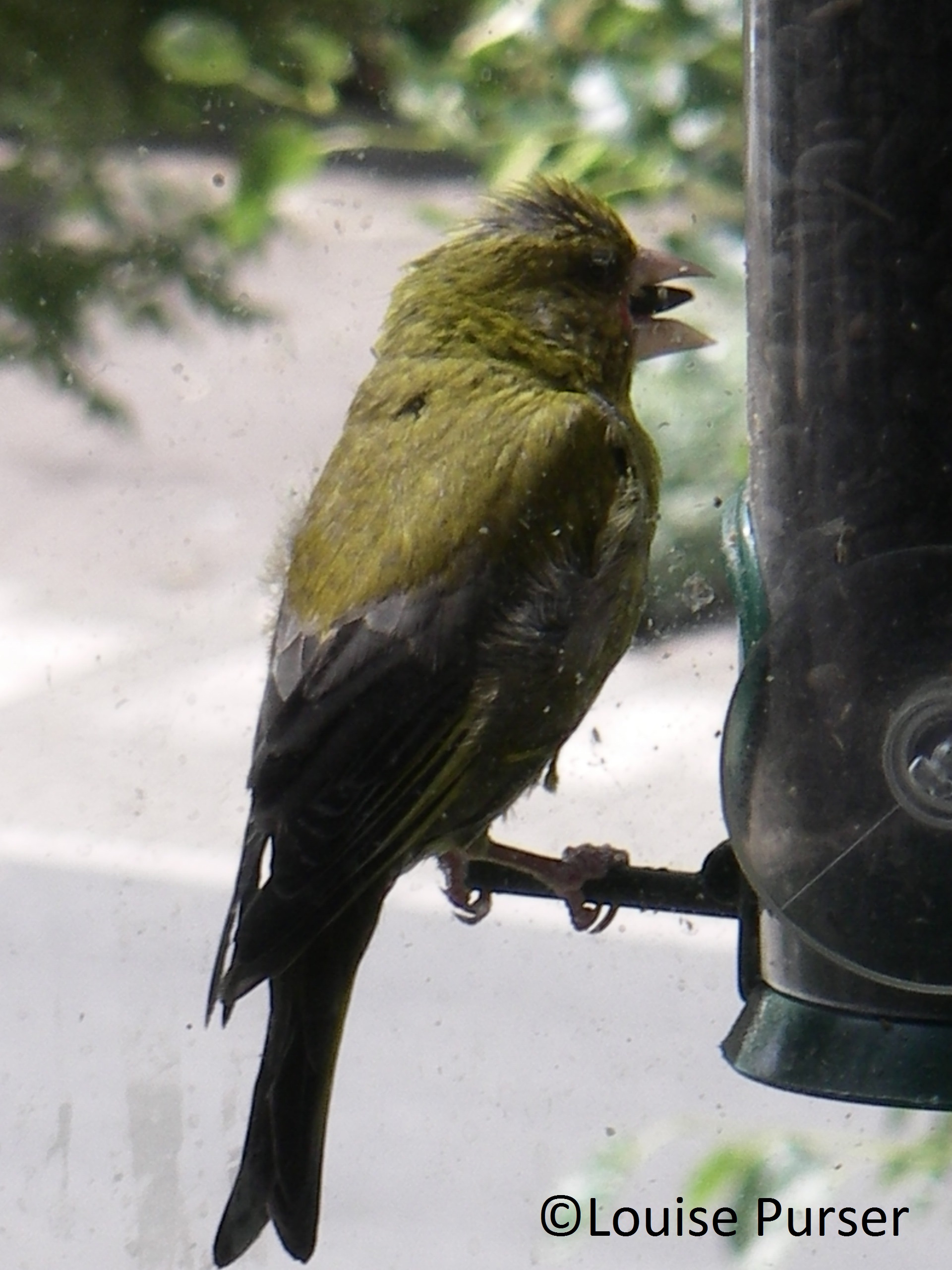
Greenfinches love black sunflower seeds
With the goldfinches in mind, I also bought a special nyjer seed feeder. The seeds are so incredibly tiny, that how they get anything of value out them is quite a mystery, and rather than eat them whole, they actually eat what’s inside of them, which must be even tinier still!
Another regular visitor is the robin. Although robins are known for being fiercely territorial, they are always very shy at the window and dash off as soon as another bird appears. They also love mealworms, suet pellets and dry, rolled porridge oats and along with the starlings, absolutely adore grated cheese. Their distinctive “peep peep” call lets you know there’s one around and likely to fly up to the window soon. The blue tits, great tits and starlings also love fat balls and coconut shell suet treats, all excellent for helping to keep them well fed during the cold winter months.
Not all birds will eat from the feeders though. The trees opposite act as hosts to woodpigeons, blackbirds, chaffinches, dunnocks, and very occasionally jays, but I am yet to see any of these at the window.
The Window Café has welcomed some unexpected but incredible guests. Great spotted woodpeckers have happily sifted through the seeds on offer, before flying to the nearest tree and hopping up its trunk. Once, a magpie landed on the tray to take a chunk of homemade fat cake which I had loaded with sunflower hearts, mealworms and dry, rolled porridge oats. It took it to a nearby roof to enjoy.
By far the noisiest and brightest of all the birds in the area is the ring-necked parakeet. I love to watch them flying overhead, screeching as they go, with their magnificent long, green tail feathers outstretched. The first time one landed on the tray feeder I could barely believe my eyes – I live in a UK city and here is a bright green parrot on my window! Far from being the brash and overconfident types they portray themselves as in the sky, the parakeets come across as quite shy and will sit in a nearby tree waiting and watching for a while before feeling brave enough to fly over. It usually takes them several attempts to land on the tray successfully due to their size and the fact the bird feeder manufacturers probably had blue tits and robins more in mind than huge exotic parrots.
Which brings me onto an important issue: if the birds are so shy, how can I get close enough to see them properly? The answer is simple: net curtains. Net curtains have a magical quality, whereby the birds can’t see you through them, but you can see them. It’s possible for me to have my face a couple of centimetres from a bird and it not even know I’m there. One movement of the curtain however and they’re off in less than the blink of an eye. The photographs I have managed to get without the net curtain, involved either using a zoom lens and standing far back, away from the window, holding the camera in front of the curtain and pressing the shutter the millisecond I saw a bird land, and taking pictures of them in the trees opposite from a distance and then cropping them.
With so many birds visiting, there are some that are more recognisable than others. At one time two blue tits were visiting (I named them both “Bill”) and each had an unusually long beak. While a blue tit’s beak is normally around 3mm long, these were more like 3cm. One beak was long and curled slightly at the end while the other had a top and bottom part that crossed over. It’s said that damage to the beak can cause it to grow this way. I haven’t seen either of the two Bills for a while and hope they are OK as deformities like this can make feeding difficult.
There is also a great tit with one leg who gets by fine; rather than perch on the edge of the tray it sits inside it to feed. Another great tit has started visiting recently whose back right foot is bent backwards in completely the wrong direction. Again, it has no problem feeding, and sits rather than perches, I just hope it isn’t in pain.
It’s spring and one of the most exciting times of year for The Window Café which is currently running as a feeding venue/crèche! The arrival of baby birds is fascinating to watch as well as completely adorable of course. The young blue tits with their yellow-feathered faces are particularly crafty. They will happily sit in the tray, feeding themselves and getting along quite nicely on their own, but as soon as a parent turns up, they behave as though they’ve never fed themselves before and launch into a tirade of the bird equivalent of “Feed me! Feed me! Feed me!” with mouths open, pestering Mum or Dad by squawking in their face.
Baby great tits behave in much the same way, while young starlings get lessons from their parents in how to jostle for best position during the feeding tray frenzy. Greenfinch chicks meanwhile have speckly feathers and look quite different to their adult parents.
When the baby birds aren’t at the window themselves, the parents are taking food to them. This is particularly notable judging by starlings’ behaviour. Usually, a starling will land and swallow as much food as possible, but during springtime, many of them instead load their beaks with softened mealworms and fly off, almost certainly to a nearby hungry youngster. With the stresses of bringing up chicks it is hardly surprising that many of the birds, from what I have seen usually blue tits and great tits, go bald.
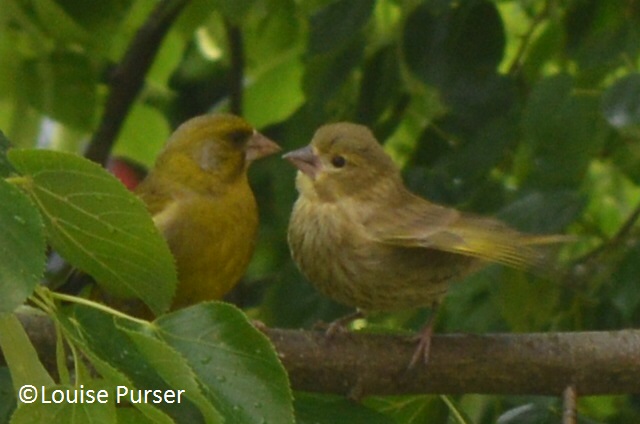
The arrival of baby birds is an adorable annual spectacle, as this young greenfinch with its parent shows
I think word of mouth – or beak, in this case – as well as observation, is the reason for the high number of visiting birds. Birds bring their chicks to the window, who may also bring their chicks later and so on. Also, if a bird sitting in a tree outside sees another fly to the window and come back with a tasty treat, it is likely to try and do the same.
The antics of the birds has become something of a soap opera, with regular dramas including violent rows, family strife and even attempted murder to rival EastEnders or Coronation Street any day. Last year a goldfinch chick – looking much like its parents but not yet with a red face – was being fed at the tray. Baby birds’ squawking is not the best way to remain inconspicuous and a nearby predator had heard its demands for food. The parents left the youngster on a branch on the tree opposite and as I watched it waiting, suddenly a jay burst out from within the foliage and attempted to grab the fledgling. But this baby bird was quick to react and flew away, the jay gave up chasing it after a few metres and returned to the tree, empty clawed.
Another time, a particularly lively young starling flapped about a bit too much while balancing on the open window and fell in, onto the window ledge between the window and net curtain. I swiftly scooped it into my hand and lifted it up and it promptly flew off, making a note to itself not to mess about on open windows again I imagine.
I hope my story will encourage others to feed the birds at home, whether it’s in a garden or at the window. My experience is proof that you don’t need a huge back garden in the countryside to get pleasure from watching the birds – as long as there are trees not too far away and you are prepared to be patient, the chances are you will eventually be rewarded by frequent visits from these fantastic creatures. My nan was a member of the RSPB and when she died I decided to carry on her good work by becoming a member myself. For more information about birds and how to help them, visit their wonderful and informative website: www.rspb.org.uk


 the dogfish press